Designing a logo with AI is possible today: type a few sentences into an image generation tool and you will see dozens of logo ideas within seconds. That is genuinely useful for the ideas stage. But an image you like on screen is not the same as a brand mark that works at every size, can be registered and that you can be sure belongs to you. We can sum up the gap in four areas: file type, similarity, trademark registration and copyright.
In short
- AI is a fast, inexpensive tool for generating logo ideas and exploring directions.
- Most image generation tools produce pixel-based (raster) files. A logo, however, needs to be vector so it stays sharp at every size.
- The generated mark may resemble an existing brand. The Turkish Patent and Trademark Office (TÜRKPATENT) rejects ex officio marks that are identical or indistinguishably similar to earlier trademarks; owners of rights can also oppose marks that are less similar.
- In the US, content generated from a prompt alone doesn't get copyright protection. In Turkey, too, the prevailing view is that the author of a work must be human.
- The safest route: use AI at the ideas stage, have a designer draw the final mark as a vector, and run a similarity search before filing for registration.
What can AI actually do for a logo?
Where AI is strong is exploration. In a few minutes, you can see different styles, color directions and composition ideas side by side. It becomes easier to discuss questions like "Geometric or hand-drawn?" or "Symbol or wordmark only?" with concrete examples.
Where it is weak is decisions and systems. The tool doesn't know what fits your brand, what your competitors use, or how the logo will look as a 16-pixel site icon or on the side of a truck. You need a process that asks and answers these questions.
Problem 1: Raster files and the need for vectors
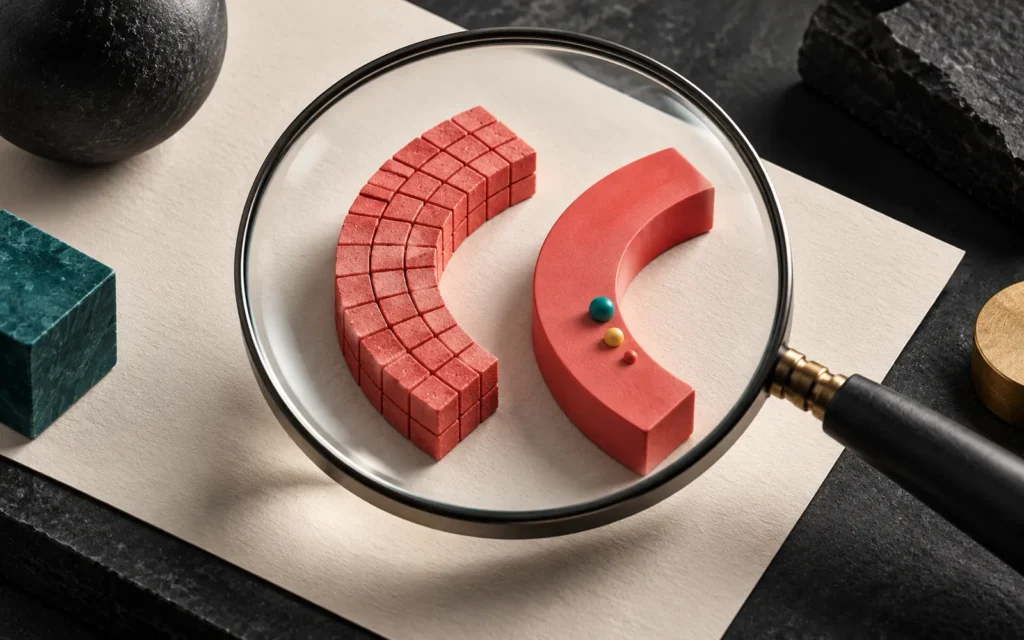
Most image generation tools deliver their results as pixel-based (raster) files such as PNG, JPEG or WebP. When you enlarge a raster image, the pixels become visible and the edges blur. A vector file (for example SVG, AI, EPS or a vector PDF), on the other hand, defines shapes mathematically and stays sharp at every size. As MDN puts it, unlike classic bitmap formats such as JPEG or PNG, vector images in SVG format can be rendered at any size without losing quality.
For a logo, this isn't a preference but a necessity. The same mark will be used on business cards, signs, packaging, embroidery and the site icon. We covered this in detail in our article on the difference between vector and raster images; for visual explanations and quizzes, you can also look at the vector and raster term on Grafik Sanat (in Turkish).
"Automatic vectorization" (image trace) may look like a solution. But automatic tracing often produces unnecessary anchor points, irregular curves and inconsistent stroke weights. The file is technically a vector, but it can cause problems in print, cutting or when scaled down. Some tools now also produce vector output directly; for example, the "Text to Vector Graphic" feature in Adobe Illustrator creates editable vector graphics from text. This reduces the file type problem, but it doesn't remove the similarity and rights problems below.
Problem 2: Similarity and originality
Image generation models work from patterns learned from a very large number of images. That is why a generic prompt such as "a minimal, modern coffee logo" often produces results close to shapes that are already everywhere: a cup, steam lines, a round frame. The result may not be an exact copy, but it may look far too much like an existing brand.
This has two consequences:
- Distinctiveness weakens. A logo close to shapes everyone uses doesn't set you apart in the customer's mind.
- Legal risk arises. Similarity can cause problems in the registration application or while the mark is in use.
Problem 3: Trademark registration and the similarity review at TÜRKPATENT
In Turkey, trademarks are registered by the Turkish Patent and Trademark Office (TÜRKPATENT) under the Industrial Property Law (SMK, Law No. 6769). The process can be summarized as follows:
- Ex officio examination (absolute grounds for refusal, SMK Art. 5): The Office examines the application on its own initiative. These grounds include marks that lack distinctive character and marks that are identical or indistinguishably similar to a trademark previously registered or applied for, for the same or the same type of goods or services.
- Publication: An application that passes the examination is published in the Official Trademark Bulletin (Resmî Marka Bülteni).
- Opposition (SMK Art. 6 and Art. 18): Within two months of publication, interested parties such as owners of earlier trademarks can file an opposition. Broader similarity assessments, such as "likelihood of confusion," are made at this stage, upon opposition.
So if a mark generated by AI is nearly identical to an existing trademark, it can be rejected outright. If there is a lesser but still noticeable similarity, you may face an opposition from the owner of the earlier trademark. Either way, effort, time and the application fee can go to waste.
Before applying, a good first step is to search for similar names and marks in the same classes using TÜRKPATENT's online trademark search tool. It is hard to catch figurative (logo) similarity fully with a text search; that is why, for an important brand, it makes sense to work with a trademark attorney. We explained the process in detail in our article on how to register a trademark.
Problem 4: Who owns the copyright?
As of June 2026, this is still an evolving area. The general framework is as follows:
- US: In a report published in January 2025, the US Copyright Office concluded that writing a prompt alone doesn't make you the author of an AI output. By contrast, elements that a human creatively selects, arranges or modifies can be protected. On the court side, the US Court of Appeals for the D.C. Circuit ruled in March 2025 in Thaler v. Perlmutter that copyright protection requires human authorship. On 2 March 2026, the US Supreme Court declined to hear the appeal in this case; the appellate ruling stands.
- Turkey: The Law on Intellectual and Artistic Works (FSEK, Law No. 5846) contains no specific provision on AI-generated output. The prevailing view in legal scholarship is that AI can't be an author, that fully autonomous output isn't protected, but that work to which a human makes a meaningful and decisive contribution can qualify as a protected work. There is no established case law on this yet.
The practical upshot: it may be hard to claim copyright in a logo that you generated from a prompt alone and use as it is. If someone else uses something similar, your strongest protection will be your registered trademark right. That, in turn, depends on an original mark that can pass the similarity review.
Also read the terms of use of the tool you use. Commercial use, rights in the output and the allocation of liability vary from tool to tool.
A logo is not a single image
A logo is only one part of a corporate identity. An identity system that works also includes:
- Horizontal, vertical and symbol-only versions of the logo,
- A simplified version for small sizes,
- A color palette (RGB for screens, CMYK for print and Pantone equivalents if needed),
- Typography, clear space rules and examples of incorrect use.
AI can give you one nice image. Building this system requires design decisions. We discussed the difference in our article on the difference between a logo and a corporate identity.
How can you use AI in the logo process?
You don't need to leave AI out entirely. A healthy way to use it could look like this:
- Exploring directions: Put together a moodboard with AI to see different styles and color directions.
- Brief: Note the examples you like and dislike, along with the reasons. This makes the conversation with the designer easier.
- Original drawing: With these directions in mind, a designer draws the final mark from scratch as a vector.
- Similarity search: Similar trademarks are checked before registration.
- Identity system: Versions, color and typography rules are prepared.
Our experience
Artsution® is a registered trademark for us too. Erdoğan Kamar's graphic design, digital drawing and web work were brought together under this registered trademark in 2024. So we know the difference between a mark that "looks good" and one that "can be registered and protected" not only from client projects but also from our own brand.
In our brand and corporate identity work, we don't have AI draw the final logo. If AI is used at all, we see it only as an aid in the early exploration stage. The final mark is drawn by hand as a vector and turned into an identity system along with its versions. Our founder Erdoğan Kamar's background in illustration and digital drawing reminds us in every project why this handcrafted part matters.
Frequently asked questions
Can I register a logo I made with AI as a trademark?
For a registration application, whether the logo was made with AI or by hand isn't decisive on its own. What is decisive is that the mark is distinctive and isn't identical or confusingly similar to earlier trademarks. AI's tendency to produce results close to common patterns creates a risk here. Run a similarity search before applying.
Is it a problem to use the PNG file AI gave me as my logo?
You might not notice when you use it small on screen. But on a sign, packaging or large print, a raster file becomes pixelated. Processes such as color separation, cutting and embroidery also require a vector file. Your logo must have a clean vector version.
Do I own the copyright in a logo generated by AI?
The answer varies from country to country and is still not settled. In the US, content generated from a prompt alone doesn't get copyright protection. In Turkey, FSEK has no specific provision; the prevailing view in legal scholarship is that the author must be human. Read the terms of the tool you use and consult a lawyer for an important brand.
Is automatic vectorization good enough?
For simple, flat-color marks, it can give acceptable results. In most cases, though, it creates unnecessary anchor points and irregular curves. A designer needs to go over the file before printing and cutting.
Conclusion
AI can be a good ideas partner at the start of the logo process. But it isn't enough on its own to produce a brand mark: file type, similarity, registration and copyright each need separate attention. For a mark that will carry your brand for many years, use the speed of AI, but make the decisions deliberately.
If you would like to work on your logo or corporate identity together, take a look at our brand and corporate identity service or write to us.
This article is for general information only and is not legal advice.
Sources9
- Industrial Property Law No. 6769 (Art. 5, 6, 16, 18), Legislation Information System (Mevzuat Bilgi Sistemi) mevzuat.gov.tr
- Erdem & Erdem, "Marka Tescilinde Mutlak Red Nedenleri" [Absolute grounds for refusal in trademark registration] (interpretation of SMK Art. 5/1-ç and ex officio examination) erdem-erdem.av.tr
- TÜRKPATENT, Marka Araştırma [Trademark search] turkpatent.gov.tr
- U.S. Copyright Office, "Copyright and Artificial Intelligence" (report parts and dates) copyright.gov
- U.S. Copyright Office NewsNet, Part 2 (Copyrightability) announcement copyright.gov
- SCOTUSblog, "Thaler v. Perlmutter" (No. 25-449, petition denied on 2 March 2026) scotusblog.com
- Şevval Şen, "Yapay Zekâ Tarafından Üretilen İçeriklerin Türk Telif Hukuku Bakımından Değerlendirilmesi" [An assessment of AI-generated content under Turkish copyright law], Terazi Hukuk Dergisi, Issue 236, April 2026 (Jurix) jurix.com.tr
- MDN Web Docs, "SVG: Scalable Vector Graphics" developer.mozilla.org
- Adobe, "Text to Vector Graphic" (Illustrator) adobe.com