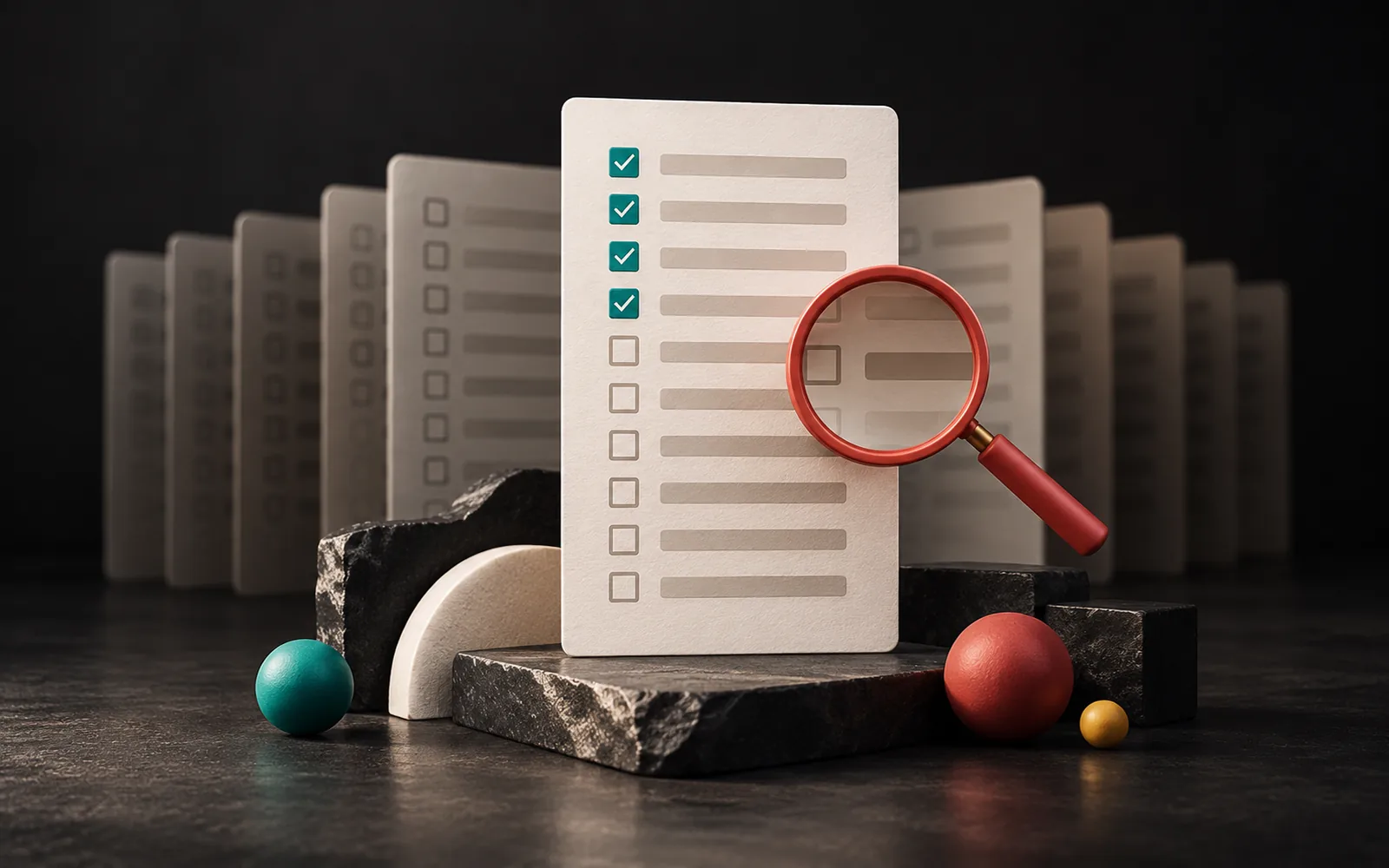
If you are wondering how to choose a design agency, don't look at how the agency describes itself. Instead, look at the concrete evidence it can show you: live work, a clear process and straight answers about what happens after delivery. In this post we share a 10-point checklist you can use to evaluate a studio. Then we ask ourselves the same questions and give our answers as Artsution. You can use the list whichever team you end up working with.
In short
- Judge an agency by its live work and how transparent its process is, not by its promises.
- Ask up front who will own the domain name, the hosting account, the design source files and the code.
- Maintenance and support after delivery matter at least as much as the design.
- You have the right to ask how the agency protects your data and at which steps it uses AI.
- Be wary of promises like "guaranteed number one ranking"; Google itself says no one can guarantee that.
Why is this such a hard choice?
Today there are plenty of options for a logo, a website or an app: freelancers, agencies, ready-made templates, AI tools. We discussed when AI alone is enough and when you need a team in our post on designers in the AI era. If you've decided to work with a team, the next question is which one.
Most agency websites say similar things: creative, experienced, customer-focused. However, those words don't help you decide. The questions below, on the other hand, call for concrete answers.
How to choose a design agency: a 10-point checklist
1. Can you open their live work yourself?
An image in a portfolio and a live website are not the same thing. Open the sites shown as references on your phone: do they load quickly, do the menus and forms work, is the content up to date? After all, live work is the most honest picture of what an agency actually delivers.
2. Who will handle everything you need?
A brand refresh often requires a logo, corporate identity, a website, social media templates and sometimes packaging or a catalog. If each of these goes to a different supplier, keeping the brand language consistent falls to you. Ask: "Which parts of this job do you do yourselves, and which do you outsource?"
3. Whose name are the domain, accounts and files in?
This is the issue that causes the most problems later on. Ask:
- In whose name will the agency register the domain? (It must be in your name. Details in our post on domain names.)
- Whose is the hosting account?
- Will you receive the source files for the logo and designs (vector files, editable design files)?
- For custom software, who will keep the source code and the database?
If you want to work with another team in the future, these answers decide everything. The choice of platform also plays a role here. For example, WordPress's built-in export tool exports posts, pages and other content to a file you can import into another WordPress site. By contrast, on some closed platforms such as Wix, the site has to run on the platform's own servers, and you can't move it to another server.
4. How does the process work, and where are the approval points?
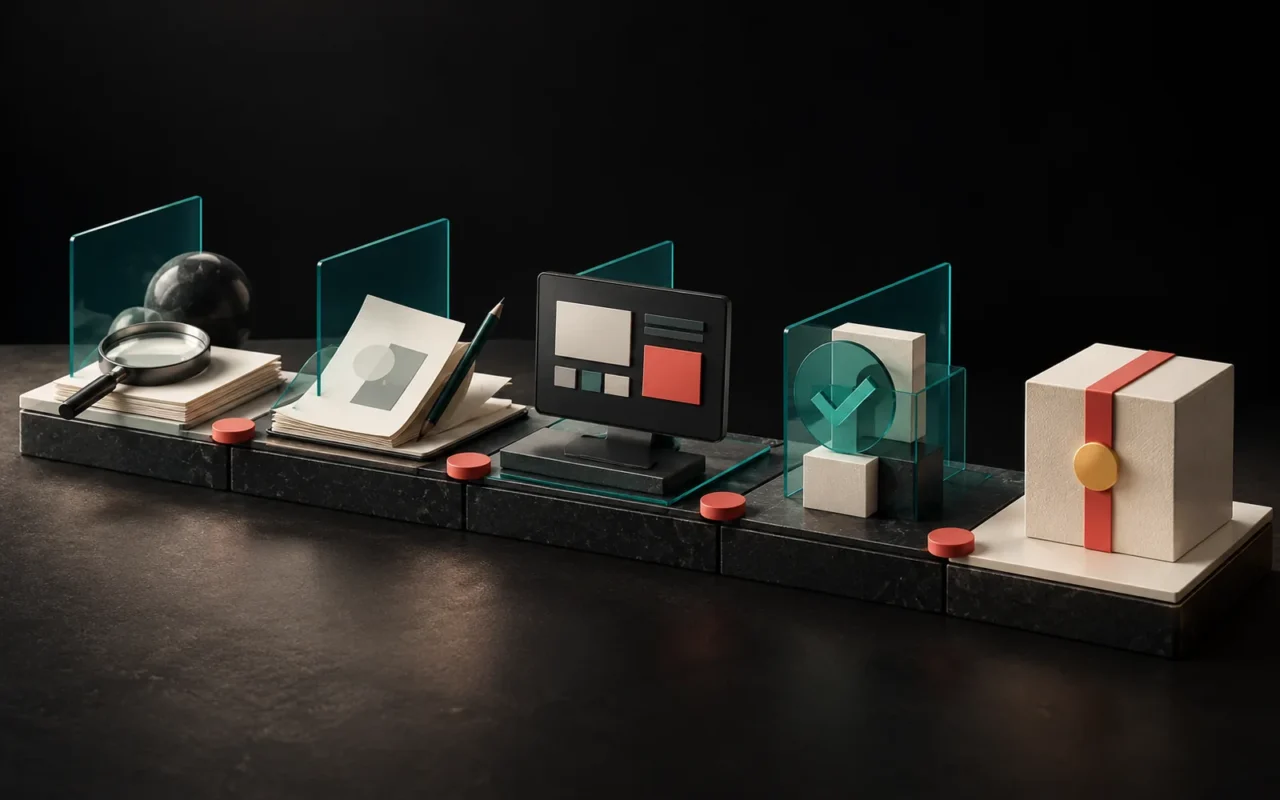
A good agency can explain its process in advance: brief, research, draft, revisions, approval, delivery. Knowing up front what you will see at each stage, how many revisions you get and what is out of scope prevents disputes later.
5. What happens after delivery?
A website isn't finished on the day of delivery. On the contrary, updates, security patches, backups and changing content need regular maintenance. Ask: "If something goes wrong after delivery, who do I contact? How do you handle maintenance?" We explained why maintenance is necessary in our post on website maintenance.
6. How do they protect your data?
An agency may have access to your site's admin panel, your customer forms or the personal data in your software. Under Article 12 of Turkey's Personal Data Protection Law (PDPL, Law No. 6698), the data controller is jointly responsible for security measures with the party that processes data on its behalf. In other words, your agency's approach to data security is also your responsibility. Ask: "How do you store my login details? Which tools does my data go into?" We covered PDPL principles in software in a separate post.
7. How do they use AI?
Today almost every agency uses AI to some degree. That isn't a bad thing; what matters is how they use it. Ask: "At which steps do you use AI? Do you produce the final logo with AI? Does my data go into an AI tool?" If you can't get a clear answer, that is a sign.
8. Are the rights to the delivered work clear?
The contract should state clearly that the logo and designs are original and who holds the usage rights after delivery. If you plan to register your logo, ask whether a similarity search is part of the process. We explained the registration process in our post on how to register a trademark.
9. Are their promises realistic?
Be wary of promises like "number one on Google in a month" or "100% guaranteed." Google's own guide says no one can guarantee a #1 ranking on Google, and that if you see someone who guarantees it, you should look for someone else. The same guide also recommends asking an SEO consultant for examples of their previous work and what kind of results they expect, and in what timeframe. These questions apply to design and software teams too.
10. Do they listen to you?
In the first meeting, notice whether the agency talks about itself or about your business. A good team asks questions before making an offer: what is your goal, who are your customers, what isn't working right now? If necessary, they should be able to say "you don't need this."
Our answers to the same questions
It wouldn't be right to write this list and leave ourselves out. We ask ourselves the same questions. Without exaggeration, and with evidence:
Live work. You can open and review our live projects yourself on our projects page. Some of them are Tuğra Karot (a service-based, SEO-friendly page structure; phone and WhatsApp actions), B2K Printing & Packaging (a bilingual corporate site), Juliette Artisan Chocolatier (WooCommerce e-commerce), Bağçepark (a product catalog and on-site survey requests), Global Basım, MyLabel, Oksijen Etiket, Meka Yapı and CMK Mekanik. We built the vast majority of these sites on WordPress.
One team. We handle brand and corporate identity, packaging and print, catalogs, social media design, illustration and technical drawing, web design, WordPress development, custom software and mobile apps in the same studio. As a result, it is easier to keep the same language across a brand, from its logo to its website. You can see all our services on our services page.
A team that runs its own products. We don't just deliver client projects; we also develop and run our own products. AquaCRM is a subscription-based service management platform for water treatment service companies. The Label Job Tracking Assistant is a product in pilot use that tracks jobs from quote to invoice for roll label manufacturers. Grafik Sanat is a free learning platform. Running a product means updates, security, user feedback and continuity. That experience is also why we take what happens after delivery seriously. We describe our products on the digital products page and what we've learned from this experience in our post What is SaaS?.
Our trademark, our use of AI and how we work
A registered trademark. Artsution® is a registered trademark. In 2024, our founder, Erdoğan Kamar, brought his graphic design, digital drawing and web work together under this brand. You can check an agency's "registered trademark" claim yourself using TÜRKPATENT's online trademark search tool. Because we went through the registration process for our own brand, we can explain to clients what to look out for regarding a logo's registrability.
Openness about AI. We have written openly, in a separate post, about the steps where we use AI and the ones where we don't (the final logo, client data, final quality control).
Ways of working. We describe different ways of working for different needs on our working models page. The page that tells you more about who we are is about us.
When might we not be the right choice?
To be honest, we may not be the right team for every job:
- If you need a single page that will be live for only a few days, an AI website builder or a ready-made template may make more sense.
- If your project depends on a technology we don't work with, a team that specializes in that area will get you better results.
We prefer to say this openly in the first meeting.
Our experience
Our own site is part of this list too. artsution.com.tr runs on WordPress, Hello Elementor and Elementor Pro; we use a LiteSpeed server and LiteSpeed Cache. For mobile speed, we made improvements such as CSS combining, locally hosted fonts, small font subsets for Turkish characters and off-screen animation optimizations. We found that LiteSpeed's "Guest Optimization" feature can delay JavaScript until the first interaction and break menus and forms, so we keep it turned off. In addition, we set up a bilingual structure with Polylang and built a plugin-free cookie consent banner compatible with Consent Mode v2. In short, we use the same methods on our own site that we recommend to our clients.
Frequently asked questions
How can I verify an agency's references?
Open the sites shown as references directly and try them on your phone. If possible, have a short conversation with the business. Treat work that appears only as images and isn't live separately.
A small studio or a large agency?
Both have advantages. Large agencies have bigger teams and more capacity, while at small studios you are more likely to talk directly to the person doing the work. What matters isn't size, but who will do your work and who you can reach after delivery.
What should I pay the most attention to when comparing proposals?
Scope. For example, two proposals that look the same can differ widely on the number of revisions, delivery of source files, content entry, training and maintenance. So put the proposals side by side by scope before comparing prices.
What else should I look for in a corporate website?
We shared a detailed checklist on this in our post on what to check before commissioning a corporate website.
Conclusion
The best way to choose a studio among thousands of options is to weigh evidence, not claims: live work, a clear process, clear ownership terms, support after delivery and honest answers about your data. You can use this list whichever team you talk to.
If you'd like to ask us these questions too, take a look at our projects or get in touch with us. We'll answer honestly, and if we aren't the right team for your project, we'll tell you that too.
Sources5
- Google Search Central, "Do you need an SEO?" developers.google.com
- Personal Data Protection Law No. 6698 (PDPL) [6698 sayılı Kişisel Verilerin Korunması Kanunu] (Art. 12) mevzuat.gov.tr
- TÜRKPATENT, Marka Araştırma [Trademark Search] turkpatent.gov.tr
- WordPress Documentation, "Tools Export Screen" (content ownership and portability) wordpress.org
- Wix Help Center, "Exporting or Embedding Your Wix Site Elsewhere" support.wix.com