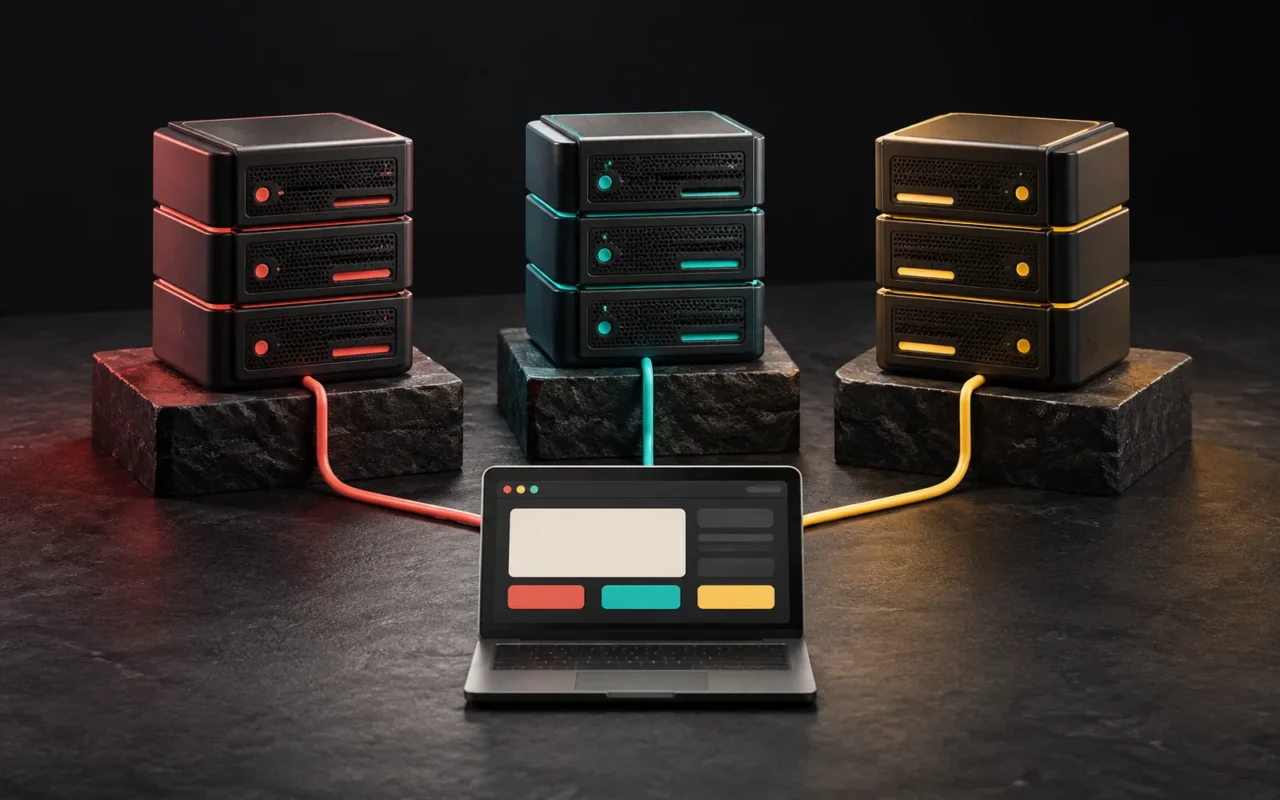
A domain name is the name people type into their browser to reach your website, such as example.com.tr. You don't buy a domain name permanently. A registrar assigns it to you for a set period, typically one to five years, and you have to renew it before it expires. Choosing the right extension, registering the domain in your own name and keeping track of the renewal date are the three things that matter most.
In short
- A domain name is the human-friendly version of a server's numeric address (its IP address). DNS does the matching between the two.
- Domain names are leased: if you don't renew before the term ends, someone else can take it.
- Since 14 September 2022, .com.tr, .net.tr and .org.tr names have been assigned without any documents, on a "first come, first served" basis.
- Register the domain in your company's name, not your agency's or an employee's.
- A transfer lock and an authorization code (EPP code) protect your domain from being moved without your permission.
What is a domain name and what does it do?
Every server connected to the internet has a numeric address called an IP address. Visitors can't remember a number like 185.xx.xx.xx, so we give the address a name. That name is the domain name.
A domain name isn't only for your website. Your business email addresses (info@example.com.tr) depend on the same domain. Losing your domain therefore means losing your email along with your website.
A domain name is made of parts separated by dots. You read it from right to left:
- Top-level domain (TLD): The rightmost part. Generic extensions such as
.comand.org, or country-code extensions such as.trand.de. - Second level: A part that indicates a category, like the
comin Turkey's.com.trstructure, or directly the name you chose. - Your name: The part that carries your brand, such as
example.
How domain names, DNS and hosting relate
These three terms are often confused. A simple analogy helps:
- The domain name is the name on your shop sign.
- Hosting is the shop where your website's files live.
- DNS is the directory that answers the question "Where is this name located?"
At the registrar where you got your domain, you specify which DNS servers (nameservers) your domain should use. When a visitor types your address, DNS translates your domain name into your server's IP address. You can get your domain and your hosting from different companies. What connects them is your DNS settings.

Which extension should you choose?
Choosing an extension is mostly a business decision, not a technical one. On its own, it doesn't decide how you rank in search engines. It matters for visitor trust and for how easily people remember you.
| Extension | Who it suits | Note |
|---|---|---|
.com.tr | Businesses operating in Turkey | Shows visitors in Turkey that you are a local business |
.com | Brands that also target other countries | Short, well-known names are often already taken |
.net.tr, .org.tr | Network services, associations and foundations | Available without documents (since 2022) |
.av.tr, .dr.tr, .edu.tr, .gov.tr, etc. | Lawyers, physicians, educational and public institutions | Assigned only with supporting documents |
A practical tip: if you have registered the .com.tr name for your brand and your budget allows, consider also registering the .com version of the same name and redirecting it to your main address. That makes it harder for someone else to use your name.
How do you register a .com.tr domain? (as of June 2024)
For many years, .tr domains were managed by nic.tr at Middle East Technical University (ODTÜ). Then Turkey's Information and Communication Technologies Authority (BTK) took over this responsibility. TRABİS (the .tr Network Information System), operated by BTK, went live on 14 September 2022. The main rules as of June 2024 are:
- You apply through a registrar. You don't apply to TRABİS directly. You choose one of the registrars authorized by BTK (the companies that sell domain names), and you pay the fee to the registrar.
- .com.tr, .net.tr and .org.tr require no documents. These names used to require documents such as a trademark registration certificate or a trade registry record. Since TRABİS, they are assigned without documents on a "first come, first served" basis. Extensions such as
.web.tr,.gen.tr,.biz.tr,.info.trand.tv.tralready required no documents. - Some extensions still require documents. Extensions that indicate a profession or an institution (for example
.av.tr,.dr.tr,.edu.tr,.gov.tr) still require supporting documents. - The registration term is at least 1 and at most 5 years. Your registrar must notify you by email at least three months before the term ends.
- Not every name is available. Names on the "names closed to registration" (TAKAL) and "restricted names" (TAKIL) lists, such as province names or words like "banka" (bank), either can't be registered or come with extra conditions.
- Selling domains isn't allowed yet. According to the TRABİS FAQ page, domain names can't be sold until three years after TRABİS went live. Details are to be announced later.
Direct ".tr" domains (example.tr)
BTK published procedures and principles for short domain names in the example.tr format, which took effect on 14 September 2023. Allocation is happening in stages: first public institutions, then certain .org.tr holders, and then holders of existing names such as .com.tr, .net.tr and .gen.tr use their priority rights. Once the priority process is complete, the remaining names will be assigned on a "first come, first served" basis.
As of June 2024, when this article was published, the priority process is still ongoing. If you own a .com.tr name and want the .tr version of the same name, you need to get the application code required for the priority application from your registrar.
What to watch out for when registering a domain
Whose name is the domain registered in?
This is the most important point. If the domain is registered in the name of your web agency, an employee or a relative, getting your address back becomes difficult once you part ways with that person. Your company should be the owner (registrant) of the domain. You can give the agency access for technical tasks, but ownership should stay with you.
Keep track of the renewal date
An expired domain stops working, and after a while it can become available for registration again. Turn on auto-renewal and make sure the email address on file with your registrar is current and checked regularly. If the credit card on file has expired, auto-renewal won't work either, so check your card details too.
Transfer lock and authorization code
For generic extensions such as .com, you need an authorization code (Auth-Code / EPP code) to move your domain to another registrar. Under ICANN rules, the registrar must provide this code within five calendar days of your request. In addition:
- While the transfer lock (registrar lock) is on, the domain can't be transferred. This lock protects against unauthorized transfers. If you want to move the domain, you remove the lock first.
- Within 60 days of the initial registration or the last transfer, the registrar can deny a transfer.
- After the registrant details (name, organization, email) are changed, transfers to another registrar can be blocked for 60 days.
For .tr domains, changing registrars is done through TRABİS and follows its own rules.
Choosing a name
- Pick a name that is short, easy to spell and doesn't get confused when said over the phone.
- Names with Turkish characters (ç, ş, ğ, ı, ö, ü) can cause problems in email and when shared. Writing these letters with their Latin equivalents is safer.
- Don't register a name that contains someone else's registered trademark. TRABİS has a dispute resolution mechanism (UÇM) for such cases, and your domain can be canceled.
- Think about the domain name together with your brand name. The way the brand is pronounced and spelled should match the address.
Common mistakes
- Registering the domain in the agency's account. Ownership should be yours.
- Tying renewal emails to an old address. The warnings never reach anyone.
- Thinking the domain and the hosting are the same thing. Changing your hosting company doesn't require moving your domain. Only the DNS settings change.
- Forgetting about business email. If the email records (MX) are deleted while you edit DNS, email stops working.
- Only looking for the cheapest registrar. Renewal fees, how usable the control panel is and the quality of support matter too.
Our experience
When we start a website project, we check from the outset whose name the domain is registered in and when it is due for renewal. If a new domain is needed, we recommend that our client's own company be the owner. Even when we handle the technical work, the login details for the registrar account stay with the client. In projects that run alongside brand work, we check domain availability while the name is being chosen. That way, nobody gets the unpleasant surprise of finding the address already taken once the logo is ready. For more, see our articles on what to check before having a corporate website built and brand identity.
Frequently asked questions
Once I register a domain, is it mine forever?
No. A domain name is assigned for a set period. For .tr extensions, that period is at least 1 and at most 5 years. If you don't renew in time, the domain stops working and can later become available for registration again.
Do I still need documents to register a .com.tr domain?
As of June 2024, no. Since TRABİS went live on 14 September 2022, .com.tr, .net.tr and .org.tr names have been assigned without documents on a "first come, first served" basis. Professional and institutional extensions (such as .av.tr and .gov.tr) still require documents.
Can I move my domain to another company?
Yes. For extensions such as .com, you remove the transfer lock, get the authorization code and start the transfer at the new registrar. For .tr names, changing registrars is done through TRABİS. You don't need to move your hosting for your website to keep working.
Should I register both .com and .com.tr?
It isn't required. If you operate in Turkey, .com.tr is usually enough. If you want to protect your brand, you can also register the other extension and redirect it to your main address.
Conclusion
A domain name looks like a small expense, but it is the foundation of your website and your email. Register it in your own name, keep track of the renewal date and keep the transfer lock on. If you are planning a new website, making the domain, hosting and DNS decisions together prevents problems later. In our web design and WordPress development projects, we plan these steps with you. If you have questions, you can write to us through our contact page.
What has changed since June 2024
Update (October 2026): The priority process for direct ".tr" domains (example.tr), which we described as ongoing in June 2024, has since been completed, and the remaining names were opened to everyone on a "first come, first served" basis. Registrar announcements date this opening to autumn 2024. The three-year sales restriction mentioned in the TRABİS FAQ also ended in September 2025. For the current rules on selling and transferring domain names, we recommend checking TRABİS announcements.
Sources9
- TRABİS — Announcements (TRABİS opened on 14 September; registration without documents) — accessed: 2026-10 trabis.gov.tr
- TRABİS — "com.tr, net.tr ve org.tr için belge istenmiyor" [No documents required for com.tr, net.tr and org.tr] — accessed: 2026-10 trabis.gov.tr
- TRABİS — Sıkça Sorulan Sorular [Frequently asked questions] (registration term, renewal notice, sales restriction, TAKAL/TAKIL, UÇM) — accessed: 2026-10 trabis.gov.tr
- BTK Board Decision 2023/İK-BTD/244 — "a.tr Yapısındaki Alan Adlarının Tahsisine İlişkin Usul ve Esaslar" [Procedures and principles for allocating a.tr domain names] (in force 14 September 2023) — accessed: 2026-10 btk.gov.tr
- NTV — "Türkiye'nin yeni dijital kimliği: .tr" [Turkey's new digital identity: .tr] (6 June 2024; priority process) — accessed: 2026-10 ntv.com.tr
- Natro Blog — "Türkiye'nin yeni alan adı uzantısı: .TR" [Turkey's new domain extension: .TR] (19 February 2024; stage dates) — accessed: 2026-10 natro.com
- Alastyr Blog — "Türkiye'de alan adı ekosistemi: .tr uzantıları ve TRABİS" [The domain name ecosystem in Turkey: .tr extensions and TRABİS] (extensions with and without documents; general opening of .tr) — accessed: 2026-10 alastyr.com
- IANA — Root Zone Database (.tr manager: BTK) — accessed: 2026-10 iana.org
- ICANN — Domain Name Transfer FAQs (60-day rule, Auth-Code, registrar lock) — accessed: 2026-10 icann.org