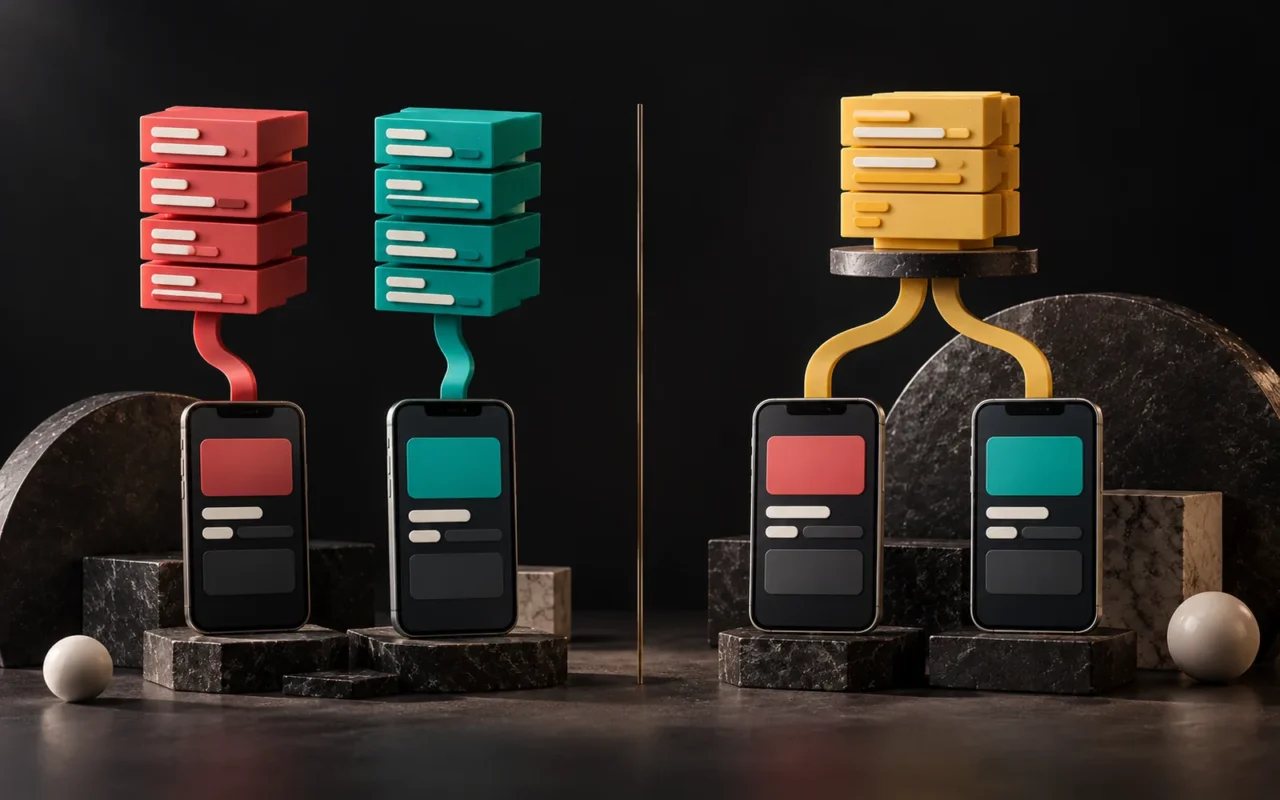
Custom software is software developed around a specific business's own workflow, rules and needs. An off-the-shelf package, by contrast, is a product designed for everyone and used by many companies at once. Which one is right depends on how unique your process is and how much the package forces you to bend.
In short
- Custom software: It is written around your processes; screens, rules and reports are shaped in the language of your business.
- Off-the-shelf package: It gets you started quickly and its upfront cost is low, but you have to fit your processes to the package.
- Custom software makes sense when your process is what sets you apart, when you are stitching several tools together by hand, or when the package's limits hold back your growth.
- Compare them not by the first price but by total cost of ownership: licenses, per-user fees, integration, maintenance and migration.
- With custom software, source code and intellectual property rights should be set out clearly and in writing in the contract.
What is custom software?
Custom software is software designed and developed for a business's needs. A panel that manages a service company's field team, a manufacturer's job tracking from order to shipment, or an order portal for a dealer network are examples. Screens, fields, approval steps and reports follow how that business actually works.
Custom software doesn't always mean "writing everything from scratch." Today most projects start from a proven framework and ready-made libraries. The custom part is the rules, data structure and screens specific to your business. If you're curious about the front-end and back-end layers of software, our post Frontend vs. Backend is a good place to start.
What is an off-the-shelf package, and what are its advantages?
An off-the-shelf package is software developed for common needs such as accounting, CRM, e-commerce or project management and offered to many customers at once. Today people use a large share of these over the internet by subscription. This model is called SaaS (Software as a Service): in the definition of the US National Institute of Standards and Technology (NIST), the user uses the provider's application running in the cloud and does not manage the servers, operating system or infrastructure.
Off-the-shelf packages have real advantages:
- Quick start: You can open an account and start using it the same day.
- Low upfront cost: Instead of a development fee, you pay a monthly or yearly fee.
- Maintenance is the provider's job: Servers, updates and security patches are mostly the provider's responsibility.
- Mature features: Common needs have been tested by many users over the years.
If most of your process is the same as other companies in your industry, an off-the-shelf package is usually the right place to start. We don't see custom software as the default answer.
When is an off-the-shelf package not enough?
If several of the following apply to you, it may be time to consider custom software:
- Your process doesn't fit the package. You change the way you work to use the package, or your team "works around" it.
- Your data is scattered across several tools. Quotes are in one place, orders in Excel, service records in another app; your team enters the same information by hand again and again.
- You need integration, but the package doesn't allow it. You want to connect with accounting, shipping, messaging or machine data; the package has no API (an interface for talking to other systems), or only a limited one.
- Per-user fees penalize your growth. As your team grows, license costs rise faster than the value the work brings in.
- Your competitive advantage lies in your process. You can't deliver the speed or transparency you offer your customers with the same package your competitors use.
- You want full control over your data. Where your data is stored, how it is backed up and who can access it are critical for you.

Comparison: off-the-shelf package vs. custom software
| Criterion | Off-the-shelf package | Custom software |
|---|---|---|
| Time to start | Short (days, weeks) | Longer (depending on scope) |
| Upfront cost | Low | Higher |
| Process fit | You fit the process to the package | The software is built around the process |
| Changes | Depend on the provider's roadmap | Follow your priorities |
| Integration | As much as the package offers | Developed as needed |
| Maintenance and security | Mostly with the provider | With you or the team you contract |
| Data and ownership | Subject to the provider's terms | Defined by contract |
| Vendor dependency | On the package provider | On the development team (reduced by documentation and source code handover) |
Total cost of ownership (TCO)
Comparing an off-the-shelf package with custom software by looking at the first invoice is misleading. For a sounder comparison, think about the total cost over several years (total cost of ownership, TCO):
- For an off-the-shelf package: per-user or per-module subscriptions, add-on modules, separate tools for integration, time spent on manual work for things the package can't do, and the cost of moving to another package later.
- For custom software: initial development, servers and hosting, maintenance and updates, new feature development, internal training.
Which of these items weighs more depends entirely on the business. We don't give a figure here, because a figure given without a defined scope would be misleading. We will cover the factors that determine cost separately.
One item that gets forgotten: manual work time. The time a team spends entering the same data in three different places doesn't show up on an invoice, but it is a real cost.
Ownership and source code: what to look for in the contract
The most overlooked issue with custom software is who the software belongs to. In Turkey, computer programs are listed among scientific and literary works in Article 2 of the Law on Intellectual and Artistic Works (FSEK, Law No. 5846). Article 52 of the law requires contracts concerning economic rights to be in writing and the transferred rights to be specified one by one.
In practice this means that when you have software built by an outside team, if there is no written arrangement covering the rights, the scope of your right to copy the software, modify it or have another team develop it can remain unclear. Make the following clear in the contract:
- Which economic rights (reproduction, adaptation, distribution, etc.) are transferred to you, or to what extent they are licensed,
- Whether the source code will be handed over, when and in what form (e.g. access to the code repository),
- Whose accounts the server, domain name, database and backups will be in,
- The license terms of third-party libraries used in the project,
- Whether technical documentation (installation, architecture, database schema) will be delivered.
For works created by your own employees in the course of their work, Article 18 of FSEK states that the rights are exercised by the employer unless otherwise agreed or implied by the nature of the work. When you work with an outside team, this rule doesn't apply directly; the contract is what decides. We recommend consulting a lawyer about your specific situation.
5 questions to ask before moving to custom software
- What exactly is the problem we want to solve? Who does which task, and in how many steps?
- Could an off-the-shelf package or a small integration solve this problem?
- Which features must be in the first version, and which can come later?
- Who will maintain the software, and how will it grow after the first year?
- Who will control the data, the source code and the server?
Once you write down the answers to these questions, you'll have far more productive conversations with both package providers and software teams.
Our experience
Our services include both WordPress-based websites and custom software projects such as CRMs, panels, SaaS and API work. That's why we don't come to the question "custom software or a ready-made solution?" with a single answer. We build most corporate websites on WordPress, because content management is what these sites really need and the ready-made structure handles it well. For Juliette Artisan Chocolatier, we also built the online store on WooCommerce, WordPress's e-commerce plugin.
We recommend custom software when the process is truly specific to the company. In our projects, the first step is to write down the existing workflow and decide together which parts ready-made tools will solve and which need custom development.
Frequently asked questions
Is custom software always more expensive?
The upfront cost is usually higher. But over a total of several years, once you factor in the number of users, integration needs and manual work, the picture can change. The right comparison is the total cost over the same period.
Can we start with an off-the-shelf package and move to custom software later?
Yes. This is a common and often sensible path. You learn the process with the package; once your needs are clear, you move to custom software. To make the move easier, check from the start whether the package lets you export your data.
Should the source code be handed over to me?
The contract sets this, and it is an important point. If the source code and documentation are handed over to you, working with another team later becomes possible. If they won't be handed over, the scope and consequences of that should be clear in writing.
Does custom software need maintenance?
Yes. The language, framework and libraries the software runs on receive updates; security vulnerabilities get patched; and as your business changes, the software changes too. Discuss a maintenance plan at the start of the project. We covered the web side of this in our post Why Is Website Maintenance Necessary?
Conclusion
Custom software isn't the right answer for every business. If your process is similar to other companies in your industry, an off-the-shelf package is usually enough. If your process is what sets you apart, if your team moves data between tools by hand, or if the package's limits hold back your growth, custom software becomes a serious option. Look at total cost and ownership when you decide. If you'd like to clarify your needs together, take a look at our Software and Digital Solutions page or get in touch with us.
This article is for general information only and is not legal advice.
Sources3
- Law No. 5846 on Intellectual and Artistic Works (Fikir ve Sanat Eserleri Kanunu; Articles 2, 18, 52), Legislation Information System (Mevzuat Bilgi Sistemi). — accessed: 2026-10 mevzuat.gov.tr
- NIST SP 800-145, The NIST Definition of Cloud Computing (SaaS definition). — accessed: 2026-10 nvlpubs.nist.gov
- MDN Web Docs — API (glossary). — accessed: 2026-10 developer.mozilla.org