A website for a water treatment company needs to carry technical credibility and sales-focused communication at the same time. When products, service, the dealer network, filter replacement and contact flows are presented with a simple architecture, users make decisions faster. In this article on water treatment web design, we explain which pages you need, what to watch for on each one and how to guide visitors toward a quote or service request.
In short
- Build the site around three main visitors: people who want to buy a unit, people who need service or a filter change, and people who want to become dealers.
- On product pages, give technical values in a table, in plain language, backed by real documents.
- Set up a separate, short request flow for service and filter replacement.
- On mobile, make phone and WhatsApp actions reachable from every page.
- State your service area and contact details clearly; this information matters in local search.
Who visits a water treatment website?
The people who come to a water treatment company's site are not all looking for the same thing. That is why you should separate visitor groups before you build the site architecture:
- Buyers: They research treatment units for a home or workplace, compare models and ask for a price or quote.
- Existing customers: They need a filter change, maintenance or a repair.
- Corporate customers: They want information and a site survey for larger systems for an office, factory or facility.
- Dealer candidates: They look for dealership terms and how to apply.
Each group should be able to reach its own path from the home page in one click. For example, four clear entry points on the home page for "Products", "Service and filter replacement", "Corporate solutions" and "Become a dealer" make this separation easy.
Why does it matter?
A well-planned digital and visual foundation makes a brand look more professional. Giving users quick access to the information they need, making sure the page experience works smoothly on mobile and structuring content for search engines all have a direct impact on conversion rates.
Because water treatment is a decision about the water customers drink, trust matters even more here. Google also describes trust as the most important element in its search quality assessment. On topics such as health and safety, accuracy carries extra weight as well.
A core page structure for water treatment web design
The following structure is a good starting point for most water treatment companies:
| Page | Purpose |
|---|---|
| Home page | Guide visitors to the right path and build trust at first glance |
| Product categories and product pages | Explain and compare models |
| Service and filter replacement | Take requests from existing customers quickly |
| Corporate solutions | Take site survey requests from office and facility customers |
| Dealership | Inform dealer candidates and take applications |
| Dealer and service locations | Show the service area and the nearest location |
| Frequently asked questions | Answer the questions most often asked on the phone |
| About and contact | Present the company, its documents and contact details |
Describing each service on its own page helps visitors find what they are looking for and helps search engines match the page to the right topic. We also covered this principle in our corporate website checklist.
Product pages: technical detail, plain language
The product page is where technical credibility is built. However, most visitors are not engineers. That is why you should present technical information in two layers.
Benefit first, then technical values
At the top of the page, explain in plain language who the product suits and what it provides. Then give the technical values in a table: treatment stages, filter types, capacity, tank volume, dimensions, power requirements and warranty terms, for example. That way, both the user who wants to decide quickly and the user looking for detail find what they need.
Make replacement filter information visible
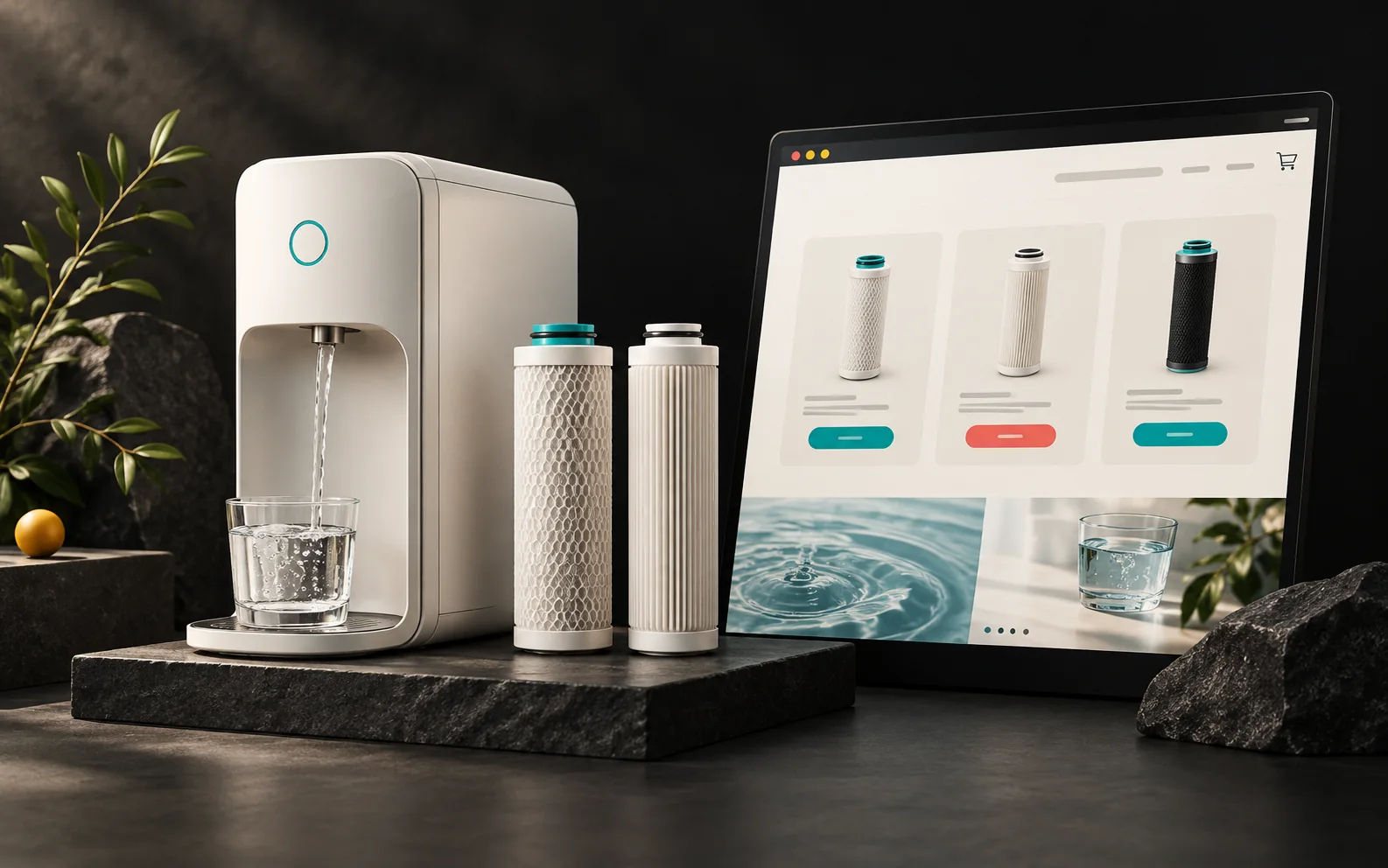
Filters in treatment units need replacing at regular intervals. For this reason, show on every product page which replacement filters the unit uses and the replacement interval the manufacturer recommends. This information builds after-sales trust and also leads naturally to the filter replacement page.
Back up claims with documents
Be careful with claims about water quality. Show the test reports, certificates and manufacturer documents you actually have. Avoid health claims that aren't backed by documents. After all, an exaggerated sentence reduces trust instead of building it.
The service and filter replacement flow
In water treatment web design, the service flow is often the section that makes the biggest difference. Existing customers usually come to the site for one job: to request service or a filter change. Keep this flow as short as possible.
- A short form: Name, phone, address or district, unit model and request type (filter change, maintenance, repair) are usually enough.
- Fast contact: Put a phone and WhatsApp button next to the form. Some customers prefer to call rather than type.
- Reminder sign-up: A field where customers can leave their filter replacement date for a reminder strengthens the recurring service relationship. However, get the necessary permissions for such messages from the start.
- Confirmation message: After the form is sent, state clearly that the request was received and when you will get back to the customer.
Also meet the duty to inform under Turkey's Personal Data Protection Law (PDPL, Law No. 6698) for the personal data you collect through forms. According to the Personal Data Protection Authority (KVKK), the data controller must disclose its identity, the purposes of processing, to whom the data may be transferred, the collection method, the legal basis and the person's rights.
Dealer network and service area
Water treatment companies often serve customers at their address. That is why you should list the provinces and districts you serve clearly on the site. If you have a dealer network, prepare a page that lists dealer and service locations by province.
Google Business Profile guidelines also provide for defining a service area for businesses that go to customers' locations. It is important that the area information on your site matches the information in your profile. In addition, marking up your address, phone number and opening hours with structured data (LocalBusiness) helps search engines read this information correctly. For details, see our article on building an SEO-friendly website for local businesses.
On the dealership page, write the terms, expectations and application steps in short bullet points. Then end the page with a simple application form.
Mobile, speed and security in water treatment web design
Customers who need service usually visit from a phone and are in a hurry. Google also evaluates sites primarily by their mobile version. For this reason, give mobile design extra care:
- Keep the phone and WhatsApp buttons fixed at the bottom of the screen or easy to reach.
- Keep forms short enough to fill in with one hand on a phone.
- Compress images and size them correctly so pages open quickly.
To measure page experience, track Core Web Vitals. Since March 2024, INP (Interaction to Next Paint), which measures responsiveness, has replaced FID. We cover this in our article what are Core Web Vitals. Finally, make sure every page with a form runs over HTTPS.
Our experience
On the websites we build for service-focused companies, we follow this approach:
- We start with an analysis of your goals, sector and competitors.
- We plan page structure and content flow around user intent.
- We build the design language to strengthen brand perception.
- We set up the technical foundation with a focus on speed, security and manageability.
- We plan post-launch measurement and improvement steps from the start.
For example, for Tuğra Karot we built the core drilling and concrete cutting services on a service-based, SEO-friendly page structure; every page has phone and WhatsApp actions. On the Bağçepark site, we presented a product catalog and made it possible to request an on-site survey directly from the site. We build most of these sites on WordPress. As a result, the company can update its product and service content itself.
Frequently asked questions
Should I show prices on a water treatment website?
That depends on your sales model. For standard home units, showing a price or price range can shorten the decision process. For corporate systems, where installation and needs vary, a site survey and quote request is more suitable.
Should I sell online, or is a quote form enough?
Standard products such as replacement filters suit online sales. For units that need installation, however, most companies prefer a quote or appointment flow. You can also set up both.
Should a company with a dealer network create a page for each dealer?
Yes, if the number of dealers and the regional structure are large enough to justify it. Giving each dealer's address, service area and contact details on a separate page helps in local search and makes things easier for users. If you have only a few dealers, a single list page is enough.
How do I set up filter replacement reminders?
A simple method is to collect the customer's replacement date and contact permissions in the service form. Then you can send reminders by email or SMS. As the number of customers and units grows, however, it is more reliable to handle this tracking with service management software.
Conclusion
Good water treatment web design combines technical credibility and sales-focused communication in the same simple structure. When the product, service, dealer, filter replacement and contact flows are clear, visitors decide faster. Successful digital work comes from thinking about design and technology together. Artsution considers not only what a brand needs today, but also the foundation it will need as it grows.
If you'd like to plan the structure of your water treatment company's site together, take a look at our web design and WordPress development services, see our software development page for specific needs such as service tracking, or get in touch with us.
This article is for general information only and is not legal advice.
Sources6
- Google Search Central — Creating helpful, reliable, people-first content developers.google.com
- Google Search Central — Mobile-first indexing best practices developers.google.com
- Google Search Central — Local Business (LocalBusiness) structured data developers.google.com
- Google Business Profile Help — Guidelines for representing your business on Google support.google.com
- web.dev — Interaction to Next Paint becomes a Core Web Vital on March 12 web.dev
- Kişisel Verileri Koruma Kurumu — Aydınlatma Yükümlülüğü [Personal Data Protection Authority — Duty to Inform] kvkk.gov.tr