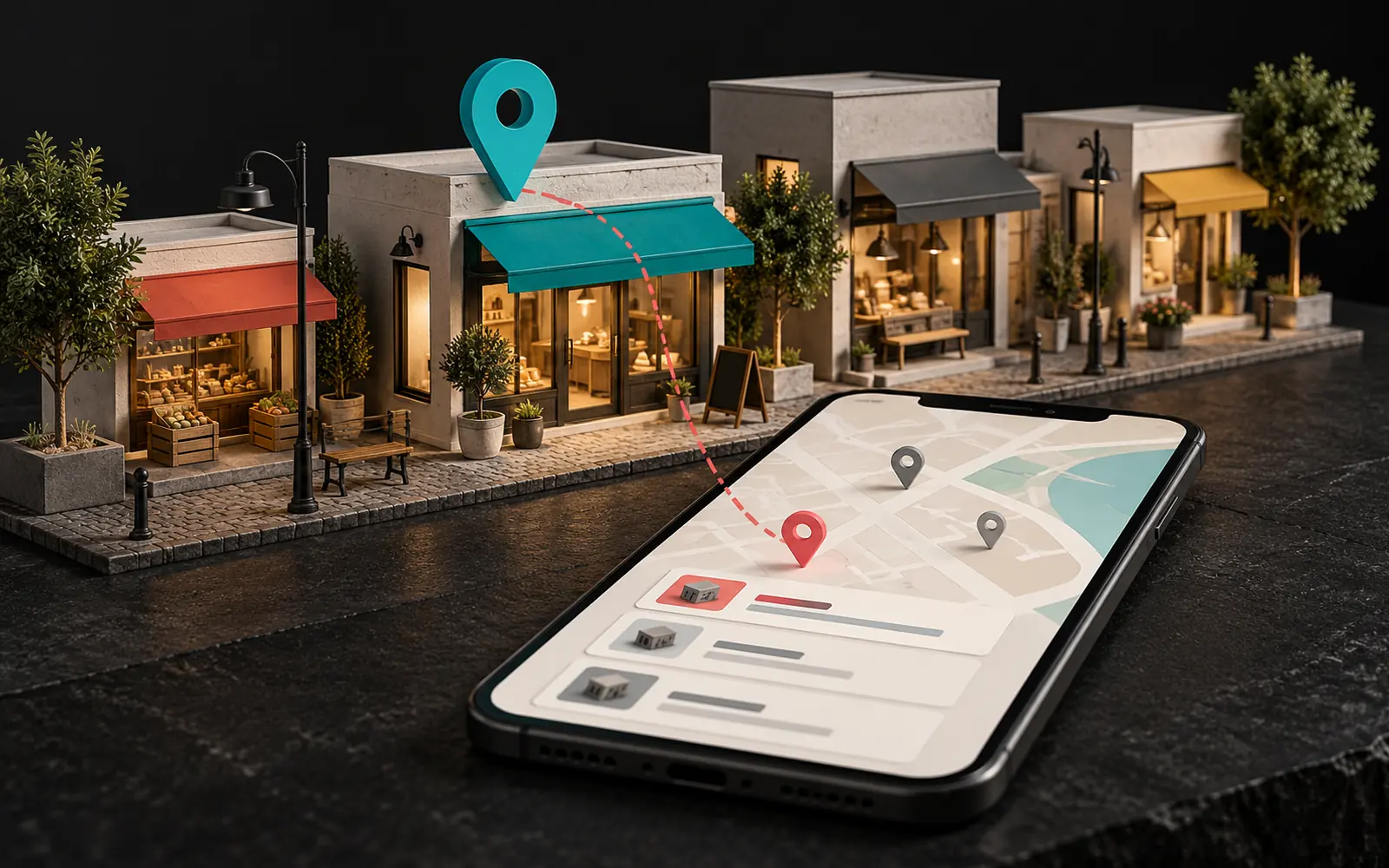
An SEO-friendly website for a local business starts with pages that clearly describe each service and the area you serve, contact details written the same way everywhere, and a structure that loads quickly on a phone. The other half of local SEO lives outside the site: your Google Business Profile. When the two are set up to support each other, your chances of appearing in "near me" searches go up.
In short
- Local SEO is the work of making you visible to customers searching for you in your area. Your website and your Google Business Profile work together.
- According to Google, three factors determine local ranking: relevance, distance and prominence. You can't pay for ranking.
- Your website should have a separate page for each service, clear information about your service area, and a name, address and phone number written the same way everywhere.
- A Google Business Profile is created under your real business name, verified and kept up to date. Reviews are requested without offering anything in return, and they are answered.
- Since the "Business Profile websites" were shut down in March 2024, you need a site on your own domain name.
What is local SEO, and why does it need separate thought?
SEO is all the work done to make your site more visible in search results. Local SEO is the location-dependent part of it. For searches such as "carpet cleaning in Beylikdüzü," "acupuncture near me" or "core drilling in Esenyurt," Google shows part of the results with a map and business cards. These cards are largely fed by the Google Business Profile. Websites are ranked in the regular results below them.
That is why a local business has two storefronts:
- Google Business Profile: The information shown on the map and in the business card, reviews, photos and opening hours.
- Website: Pages that describe your services in detail, build trust and lead the customer to call or send a message.
The profile brings the customer to you; the site gets them to decide "I'll work with this company." When one is missing, the other is weaker too.
How does Google rank local results?
On its Business Profile help page, Google explains that local ranking is based on three main factors:
| Factor | What it means | Your influence |
|---|---|---|
| Relevance | How well your profile and site match what is being searched for | High: the right category, clear service descriptions, detailed pages |
| Distance | How far the searcher is from your business | Low: you can't change your address, but you can define your service area correctly |
| Prominence | How well known the business is: reviews, links, presence on the web | Medium: regular reviews, good content, genuine recognition |
The same page states it plainly: there is no way to request or pay for a better local ranking on Google. Ads are a separate area and don't buy organic ranking. We recommend viewing offers that say "We'll get you to the top of the map" in that light.
What to do on your website
1. A separate page for each service
The most common gap we see is all services listed in a few lines on a single "Our Services" page. For Google to match a page with a search for "core drilling," that page has to actually describe core drilling: what jobs it is used for, which diameters you work with, how the process works and which areas you travel to.
Every service page should include:
- A clear heading and page title that name the service
- Answers to the questions customers actually ask
- Real job photos (not stock photos)
- Call and message buttons reachable from anywhere on the page
2. State your service area clearly
If you go to the customer (service calls, cleaning, towing, renovation and so on), write out in text which districts you serve. A service area section is enough. Producing pages for each district where the content is identical and only the district name changes doesn't work. Those pages tell the visitor nothing new. If you genuinely have different information for a district (your branch there, your team, the jobs you've done), a separate page makes sense.
3. The same name, address and phone number everywhere
Your business name, address and phone number should be written exactly the same in the site footer, on the contact page, in your Business Profile and on your social media accounts. Inconsistencies such as "St." versus "Street," two different phone numbers or an old address confuse both customers and search engines. This is less an official Google rule than a matter of good housekeeping: when there is one correct version of the information, everyone ends up in the same place.
4. Fast and easy on a phone
A large share of local searches is made from phones. In October 2023, Google also announced that sites are now indexed based on their mobile versions (mobile-first indexing). So:
- The phone number should be clickable (a
tel:link). - Location, map and directions should open with a single tap.
- The page should load in a reasonable time on mobile data too. Unnecessarily large images and heavy animations are the first things to cause problems.
We cover how visitors use a site in more detail in our post on user experience (UX).
5. Trust signals
Before deciding, a local customer checks whether "this company is real." Real photos of your team and work, a visible address, opening hours, examples of completed jobs and a site served over an SSL certificate answer that question.
6. Local business structured data
Structured data is code that describes the information on a page to search engines in a machine-readable way. Google supports the LocalBusiness type for local businesses and recommends using the most specific subtype (for example, Restaurant for a restaurant). Name and address are required; phone, opening hours, location and web address are recommended. This code doesn't bring rankings on its own, but it helps keep the information on the site consistent and clear.

How to set up a Google Business Profile
Google Business Profile is your free business listing that appears in Google Search and Maps. When setting it up, it is important to follow Google's guidelines, because profiles that break the rules can be suspended.
- Real business name: The name should be the real name you use on your signage and documents. The guidelines don't allow unnecessary information to be added to the name. Names stuffed with keywords, such as "Ahmet's Boiler Service Cheap Fast 24/7," break the rules.
- One profile: There should be one profile per business (and per branch).
- Address: If you have a location customers visit, show the address. If you only go to customers (a service-area business), the guidelines ask you to hide the address. Virtual office and mailbox addresses are not accepted.
- Category: Choose the fewest categories that describe your core business. A category is not a list of services.
- Verification: Until you verify the profile, Google can't know that you represent the business. The verification method varies by business.
- Complete information: Opening hours, phone, website address, services and real photos. Google states that businesses with complete and accurate information are more likely to appear in local results.
Business Profile websites have shut down
Google shut down in March 2024 the simple websites created through Business Profile. Visitors to these sites were redirected to the business profile for a while, and that redirect also ended on 10 June 2024. If you used one of these sites, the website field in your profile may now point to an empty address. You need to set up a site on your own domain name and update the link in your profile.
Reviews: what to do and what not to do
Google says that more reviews and positive ratings can help local ranking. Responding to reviews also shows customers that you value their feedback.
What you should do:
- After the job is done, ask satisfied customers for a review with a short message.
- Reply calmly and concretely to all reviews, positive and negative.
What you should not do:
- Don't offer discounts, gifts or money in exchange for reviews. Google's content policies count this as fake engagement.
- Don't use reviews that were bought or that aren't based on a real experience.
Common mistakes
- A one-page "business card site": It loads fast, but it has no content to tell the search engine about.
- Copy-paste district pages: The same text with a different district name. It adds no value for the visitor.
- A keyword-stuffed business name in the profile: It may seem to work in the short term, but it puts the profile at risk of suspension.
- Outdated information: You moved or your number changed, but the profile and site weren't updated.
- No phone number to be found on the site: Most local customers want to call or send a message.
Our experience
We follow the same structure on the sites we build for businesses that serve a local area: a separate page for each service, a clear service area and contact actions reachable from every page.
For example, for Tuğra Karot we built the core drilling and concrete cutting services with a service-based, SEO-friendly page structure. Every page has phone and WhatsApp actions, because in this sector customers often call from a construction site, from their phone and with an urgent need. On the Bağçepark site, we presented saplings and landscaping products in a catalog structure and made it possible to request an on-site survey directly from the site. We build most of these sites on WordPress, so business owners can update the content themselves.
You can see our other local business projects on our projects page.
Frequently asked questions
Do I need a website if I already have a Google Business Profile?
Yes. The profile makes you visible on the map, but it has limited room to describe your services in detail and set you apart from competitors. In addition, the simple websites Google offered through Business Profile were shut down in March 2024. A site on your own domain name is the only digital address you fully control.
If I hide my address, will I disappear from local searches?
If you serve customers at their location, Google's guidelines ask you to hide your address and define a service area. In that case, your profile can still appear in searches within the area you defined. Hiding the address isn't the problem; using a wrong or virtual address is.
Should I create a separate page for each district?
Only if you can give real, district-specific information on each page. Duplicating the same text and changing the district name adds nothing for the visitor. For most businesses, a single service area section and strong service pages are a better starting point.
How long does local SEO take to show results?
It wouldn't be right to give a fixed timeframe. Results depend on your competitors, your area, how complete your profile and site are, and how reviews accumulate. Verifying the profile and correcting information can be done quickly; content and reviews build up over time.
Can I pay to rank higher on the map?
No. Google clearly states that there is no way to request or pay for a better local ranking. You can advertise with Google Ads, but that doesn't change your organic local ranking.
Conclusion
Local SEO is less a big-budget campaign than a set of basics done regularly and correctly: pages that describe each service, consistent contact details, a site that is easy to use on a phone and a complete Google Business Profile. Once that foundation is in place, reviews and content build on top of it over time.
If you'd like to build this structure together for a business that serves your area, take a look at our web design and WordPress development services, or get in touch with us.
Update (October 2026): In February 2026, Google began gradually rolling out AI Mode and AI Overviews in Turkey. Google's guidance on AI features states that there are no additional requirements to appear in these features and that foundational SEO practices still apply. The same guidance also recommends keeping your Business Profile information up to date. The basic steps in this post have not changed.
Sources9
- Google Business Profile Help — Tips to improve your local ranking on Google support.google.com
- Google Business Profile Help — Guidelines for representing your business on Google support.google.com
- Google Business Profile Help — Add and verify your business on Google support.google.com
- Google Maps user contributed content policy — Fake engagement support.google.com
- Search Engine Journal — Websites Created With Google Business Profiles To Shut Down In March (29 February 2024) searchenginejournal.com
- Google Search Central — Local Business (LocalBusiness) structured data developers.google.com
- Google Search Central Blog — Mobile-first indexing has landed (31 October 2023) developers.google.com
- Google Turkey Blog — Türkiye'de AI Modu ve AI Bakışı Dönemi Başlıyor [The era of AI Mode and AI Overviews begins in Turkey] (18 February 2026, for the update box) blog.google
- Google Search Central — AI features and your website (for the update box) developers.google.com